Wednesday, 29 December 2010

Indonesia 2 - 1 Malaysia


We won 2 - 1, but it isn't enough for us to win the cup.
Never mind, great game!!!! We are proud of you, my beloved national team...
Watching the match give me a chill i have never felt before. The energy, the passion of every single Indonesian today become one. Love Indonesia. Thank you very much national team for bringing unity to the whole country.
#LoveIndonesia became Trending topic tonight on Twitter.

Indonesia VS Malaysia, second leg


the second leg of the 2010 AFF Cup Final is about to begin.
The Malaysian defeated Indonesia 3 - 0, most Indonesian can't accept that defeat due to the laser incident during the game. Malaysian supporter keep distracting Indonesian player with laser during the match. And Indonesian player walk out in order to protest.
However, the match resumed, but Malaysian scored one minute later. And Indonesian player lost their concentration and the Malaysian scored two more goals in the next 14 minutes.
Now, The Indonesian have to score at least 3 goals without conceiving any goal in order to force extra time, or they have to win with at least with 4 goals different.
It is a difficult task, but nothing is impossible in football.
Today everyone is so enthusiastic about the game in Jakarta. you can see people wearing Indonesian national team jersey everywhere. Everyone is hoping and praying for the victory today.
Viva Indonesia!!!!!!

Tuesday, 28 December 2010

Japanese Soldier Stayed In China To Atone For Japan’s Crimes


Japanese Soldier Stayed In China To Atone For Japan’s Crimes

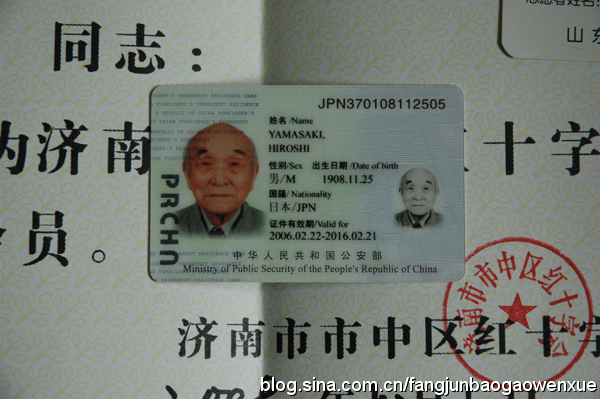
Yamasaki Hiroshi, a Japanese Imperial Army defector who stayed in China and practiced medicine.
From Tiexue:

A conscientious Japanese veteran who remained in China has passed away, let us pay our respects

The Chinese ID card of Yamasaki Hiroshi, a Japanese Imperial Army defector.
Yamasaki, following the 1937 Lugou Bridge Incident [aka "Marco Polo Bridge Incident"], landed in Tianjin with the Japanese invading army. Owing to the Japanese army killing and destroying everything in its path, accompanying medical officer Yamasaki could no longer watch any further and soon fled. He headed towards the tip of the Shandong peninsula because there it was closest to Japan, and he hoped to flee the war of aggression against China.
Yamasaki Hiroshi recently passed away at the age of 103.
Due to continuous warfare and war disasters, Yamasaki continuously hid amongst the people in Shandong practicing medicine, all the way until the founding of the New China.
After the liberation, Yamasaki remained with the Jinan City medical center and community hospital serving the Chinese people. He said to me: “The Japanese army committed heinous crimes in China and I must stay in China my entire life to atone for them.”
Members of a clinic where Yamasaki Hiroshi worked, hiding amongst the Chinese people.
All of the members of the clinic
Former Japanese Imperial Army medical officer Yamasaki Hiroshi seeing Chinese patients.
Examining Chinese patients.
Yamasaki Hiroshi.
Laying roots in China
Yamasaki Hiroshi writes what part of the Japanese Imperial Army he once belonged to.
His original army/regiment----Following the 1937 Lugou Bridge Incident, the Japanese invading army landed in Tianjin
Yamasaki Hiroshi writes about his hope to make amends for what the Japanese did to the Chinese in World War II.
In his own handwriting: "As the moon has light, the people have friendship/kindness" expressing his wish to stay in China until his death to make amends
A photographer takes a photo of Yamasaki Hiroshi.
Yesterday, at 103-years-old, elderly Mister Yamazaki passed away. He died a natural death and passed away peacefully.
Yamasaki Hiroshi in a picture with several Chinese people.
The Chinese people are a people who distinguish gratitude and resentment. The Chinese people will always remember kind-hearted people, no matter what nationality..

Monday, 27 December 2010

Porn Star with and without Make Up


Crissy Moran


Pheonix Marie


Jenna jameson


Stormy Daniels


Natasha Nice


Tara Lynn Fox


hehehehhe

Working Right After Christmas

When most people are still enjoying their holiday, today i have to go to work. So so under motivated. But not much I can do for the moment, still needed the salary. Hoping to find a way out soon.

Mongolia’s Homeless Living Underground In Sewers

Ulaanbaatar’s [or Ulan Bator, the capital of Mongolia] winters are very cold, its temperatures reaching -25 degrees Celsius. Therefore, for those homeless people without homes to return to, winter is a relatively difficult season, and they have no choice but to go underground and near the heating pipes to avoid the winter cold. When it gets dark, like ants, they crawl into shared areas [underground], not blocking the roads, with no need at all to evict them, “absolutely” not harming the city’s appearances. Photographer: Paul Bronstein. Editor: Wang Pinwei. Photograph source: CFP.

A homeless Mongolian emerges from the sewer in Ulaanbaatar.
2000 October 15, Ulaanbaatar, the 8-month pregnant 17-year-old young girl Altanchimeg crawls out from “home” to look for her livelihood. Altanchimeg says she has been living in this city for 8 years.
Mongolian girls preparing food in their underground home.
2000 October 15, Ulaanbaatar, Altanchimeg (right) and her friend Tsetsegee are at “home” preparing a meal, the two of them taking care of and depending on each other in life. Every winter, they live beside a nearby heating pipe to hide from the cold winter.
Two Mongolian girls living in the sewers, reading a book by candlelight.
2000 October 15, Ulaanbaatar, Altanchimeg is brushing her hair, Tsetsegee (front) is on the side reading a book by candlelight.
A drunk Mongolian boy collapsed at the entrance of his underground home.
2000 October 15, Ulaanbaatar, 11-year-old youth Menhtor, who has already learned how to get drunk, lies dazedly at the entrance to “home”.
A drunk young Mongolian boy passed out on the entrance to his home in the sewers of Ulaanbaatar, Mongolia.
2000 October 15, Ulaanbaatar, dead drunk Menhtor is asleep, having collapsed on the manhole cover.
A Mongolian woman looks up out of the manhole that is the entrance to her underground sewer home.
2010 March 16, Ulaanbaatar, 36-year-old Erdenetsetseg sits at “home” observing a sky the size of a manhole cover. Five years earlier, Erdenetsetseg arrived in Ulaanbaatar. Without work, she has survived by collecting trash.
A homeless Mongolian in Ulaanbaatar lies on underground heating pipes.
2010 March 16, Ulaanbaatar, Erdenetsetseg lies on a heating pipe to sleep.
A Mongolian who lives in the sewers uses cardboard as a door.
2010 March 16, Ulaanbaatar, to make it more convenient to enter and exit, Erdenetsetseg uses cardboard [instead of the manhole cover] as a “front door”. To this end, she has also poked a hole in the cardboard to allow air circulation.
A homeless Mongolian man sticks his head out of the sewers.
2010 March 15, Ulaanbaatar, Naranbaatar sticks his head out from his “home”, to feel the wind bask in the sun.
A drunk homeless Mongolian man crawls into his underground home.
2010 March 16, Ulaanbaatar, drunk Naranbaatar lies at the hole, looking into his own “home”.
A Mongolian man asleep in the sewer by the open manhole cover.
2010 March 16, Ulaanbaatar, deep night, a male falls asleep with the “door” open.
A Mongolian child yawns while sitting on a bed pan in an underground sewer that serves as his home.
2010 March 16, Ulaanbaatar, 18-month-old baby boy Munkhorgil is sitting on his “home’s” bed pan yawning. Perhaps he should be called “sewer child” ["sewer second generation"].
A mother hugs her daughter at the mouth of their underground sewer home in Mongolia.
Nikon Photo Contest International 2002-2003 winner: “Love and Peace (Ouyaa And Tsetsegee)”. In Mongolia’s Ulaanbaatar city center, a mother hugs her daughter at the “front door of her home”. The photographer successfully captured a rare expression of happiness of the “underground people”, showing their dignity of their lives. Photographer: James W. Hill (UK).
Some more photographs from Sohu:
ULAAN BAATAR, MONGOLIA-MARCH 16 : Erdenetsetseg,36, tries to keep warm down inside the sewer  filled with garbage where she lives  March 16, 2010  in Ulaan Baatar, Mongolia. Erdenetsetseg moved to the capitol city from a province, without work she collects cans and bottles to make enough money to buy a little food and vodka. Since 70 years of communist rule ended in 1990, Mongolia has become one of the most pro-business countries. While economic reforms have brought prosperity to Ulaan Baatar, there still widespread unemployment, some used to work in the now defunct state industries. Approximately over 35% of Mongolians live below the poverty line, many unable to buy basic food needed to survive. Social problems include depression, alcohol abuse, domestic violence and crime. Mongolia suffers with a very high number of alcoholics, all consuming cheap Mongolian vodka that is readily available to the poor and the unemployed, Many Mongolians have immigrated to the capitol city from the far away provinces seeking employment.  For the homeless during the winter this means extreme hardship, for some homeless living in the sewers means warmth verses dealing with temperatures dropping as low as -25C mid- Winter. This year Mongolia has experienced the worst winter in 30 years. (Photo by Paula Bronstein /Getty Images)
Erdenetsetseg, 36-years-old, is huddling her body for warm. Mongolia’s winters are very cold, the temperatures reaching -25 degrees Celsius. Therefore, for those homeless people without homes to return to, winter is a relatively difficult season, and they have no choice but to go into the city’s sewer system to live.
ULAAN BAATAR, MONGOLIA-MARCH 13 : Erdenetsetseg,36, drink vodka, living in a sewer filled with garbage  March 13 2010  in Ulaan Baatar, Mongolia. Erdenetsetseg moved to the capitol city from a province five years ago, without work she collects cans and bottles to make enough money to buy a little food and her daily fix of vodka.  Since 70 years of communist rule ended in 1990, Mongolia has become one of the most pro-business countries. While economic reforms have brought prosperity to Ulaan Baatar, there still widespread unemployment, some used to work in the now defunct state industries. Approximately over 35% of Mongolians live below the poverty line, many unable to buy basic food needed to survive. Social problems include depression, alcohol abuse, domestic violence and crime. Mongolia suffers with a very high number of alcoholics, all consuming cheap Mongolian vodka that is readily available to the poor and the unemployed, Many Mongolians have immigrated to the capitol city from the far away provinces seeking employment.  For the homeless during the winter this means extreme hardship, for some homeless living in the sewers means warmth verses dealing with temperatures dropping as low as -25C mid- Winter. This year Mongolia has experienced the worst winter in 30 years. (Photo by Paula Bronstein /Getty Images)
Erdenetsetseg often drinks until she is dead drunk.
ULAAN BAATAR, MONGOLIA-MARCH 16 :  A homeless man warms up inside a homeless shelter, taking a night off from life in the sewer March 16, 2010  in Ulaan Baatar, Mongolia. Since 70 years of communist rule ended in 1990, Mongolia has become one of the most pro-business countries. While economic reforms have brought prosperity to Ulaan Baatar, there still widespread unemployment, some used to work in the now defunct state industries. Approximately over 35% of Mongolians live below the poverty line, many unable to buy basic food needed to survive. Social problems include depression, alcohol abuse, domestic violence and crime. Mongolia suffers with a very high number of alcoholics, all consuming cheap Mongolian vodka that is readily available to the poor and the unemployed, Many Mongolians have immigrated to the capitol city from the far away provinces seeking employment.  For the homeless during the winter this means extreme hardship, for some homeless living in the sewers means warmth verses dealing with temperatures dropping as low as -25C mid- Winter. This year Mongolia has experienced the worst winter in 30 years.  (Photo by Paula Bronstein /Getty Images)
A homeless person exiting the sewer.
ULAAN BAATAR, MONGOLIA-MARCH 16 :  A homeless man warms up inside a homeless shelter, taking a night off from life in the sewer March 16, 2010  in Ulaan Baatar, Mongolia. Since 70 years of communist rule ended in 1990, Mongolia has become one of the most pro-business countries. While economic reforms have brought prosperity to Ulaan Baatar, there still widespread unemployment, some used to work in the now defunct state industries. Approximately over 35% of Mongolians live below the poverty line, many unable to buy basic food needed to survive. Social problems include depression, alcohol abuse, domestic violence and crime. Mongolia suffers with a very high number of alcoholics, all consuming cheap Mongolian vodka that is readily available to the poor and the unemployed, Many Mongolians have immigrated to the capitol city from the far away provinces seeking employment.  For the homeless during the winter this means extreme hardship, for some homeless living in the sewers means warmth verses dealing with temperatures dropping as low as -25C mid- Winter. This year Mongolia has experienced the worst winter in 30 years.  (Photo by Paula Bronstein /Getty Images)
Surrounding the heating pipes to stay warm.
ULAAN BAATAR, MONGOLIA-MARCH 16 :  A homeless man warms up inside a homeless shelter, taking a night off from life in the sewer March 16, 2010  in Ulaan Baatar, Mongolia. Since 70 years of communist rule ended in 1990, Mongolia has become one of the most pro-business countries. While economic reforms have brought prosperity to Ulaan Baatar, there still widespread unemployment, some used to work in the now defunct state industries. Approximately over 35% of Mongolians live below the poverty line, many unable to buy basic food needed to survive. Social problems include depression, alcohol abuse, domestic violence and crime. Mongolia suffers with a very high number of alcoholics, all consuming cheap Mongolian vodka that is readily available to the poor and the unemployed, Many Mongolians have immigrated to the capitol city from the far away provinces seeking employment.  For the homeless during the winter this means extreme hardship, for some homeless living in the sewers means warmth verses dealing with temperatures dropping as low as -25C mid- Winter. This year Mongolia has experienced the worst winter in 30 years.  (Photo by Paula Bronstein /Getty Images)
At night, they can only use candles for light.
ULAAN BAATAR, MONGOLIA-MARCH 13 : Erdenetsetseg,36, drinks vodka sitting on a water pipe, also used as her bed living in a sewer filled with garbage  March 13 2010  in Ulaan Baatar, Mongolia. Erdenetsetseg moved to the capitol city from a province five years ago, without work she collects cans and bottles to make enough money to buy a little food and her daily fix of vodka.  Since 70 years of communist rule ended in 1990, Mongolia has become one of the most pro-business countries. While economic reforms have brought prosperity to Ulaan Baatar, there still widespread unemployment, some used to work in the now defunct state industries. Approximately over 35% of Mongolians live below the poverty line, many unable to buy basic food needed to survive. Social problems include depression, alcohol abuse, domestic violence and crime. Mongolia suffers with a very high number of alcoholics, all consuming cheap Mongolian vodka that is readily available to the poor and the unemployed, Many Mongolians have immigrated to the capitol city from the far away provinces seeking employment.  For the homeless during the winter this means extreme hardship, for some homeless living in the sewers means warmth verses dealing with temperatures dropping as low as -25C mid- Winter. This year Mongolia has experienced the worst winter in 30 years. (Photo by Paula Bronstein /Getty Images)
Drinking alcohol has become their only pleasure.